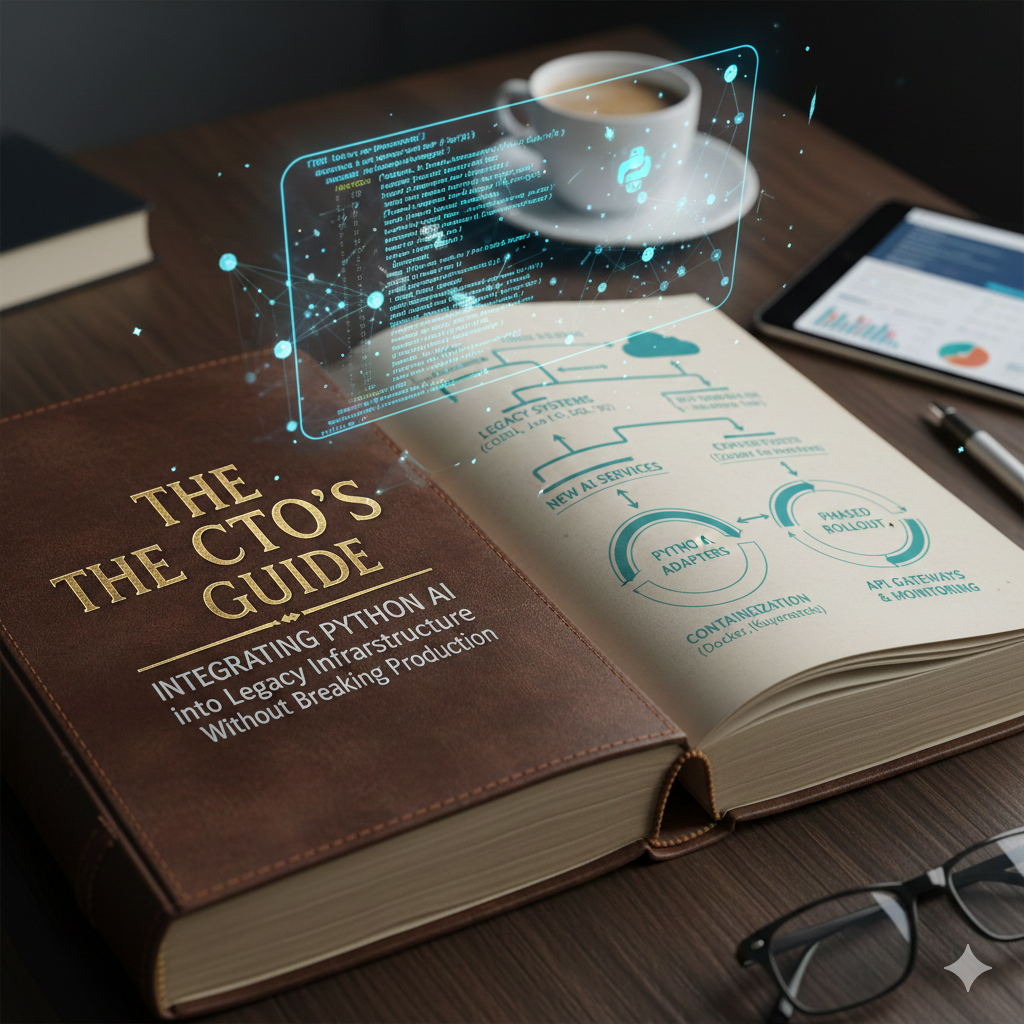
Artificial Intelligence is everywhere, but for enterprise leaders, the reality is starkly different from the hype. While startups build on greenfield cloud architectures, you are likely managing critical operations on legacy systems monoliths, older SQL databases, or on-premise servers that cannot simply be “turned off.”
The challenge isn’t building the AI model. The challenge is integration.
How do you inject modern predictive capabilities into a system built 15 years ago without introducing latency, security risks, or downtime?
The answer lies in Python’s unique ability to act as a “glue layer.” This guide explains the architectural patterns we use to bridge the gap between modern AI and legacy stability.
The Reality: Why “Rip and Replace” Fails
Most enterprises operate on a complex web of tightly coupled dependencies. Replacing these core systems to accommodate AI is rarely an option due to:
- High Risk: Migrating core logic creates massive regression testing burdens.
- Downtime Costs: Critical workflows cannot be paused.
- Data Gravity: Decades of historical data reside in legacy formats.
You do not need to rebuild. You need to extend.
The Architecture: Python as the Bridge
As Python experts, we don’t try to force AI into your legacy code. Instead, we use a Sidecar or Microservice Architecture.
Python excels here because of its rich ecosystem of integration libraries (FastAPI, Celery, SQLAlchemy). We treat the AI model as an independent service that “talks” to your legacy system via secure channels.
The 3 Most Effective Integration Patterns
Here is how we technically solve the integration problem for our clients:
- The API Wrapper (REST/gRPC) We wrap your Python AI models in a lightweight framework like FastAPI.
- How it works: Your legacy system makes a standard HTTP request (REST) to the Python service with data (e.g., a customer ID). The Python service processes this, runs the AI inference, and returns the result (e.g., a churn risk score).
- Benefit: Zero changes to your legacy database structure.
- Asynchronous Processing (The “Queue” Method) For heavy AI workloads (like image processing or complex forecasting), we don’t want to slow down your main application.
- How it works:Your legacy system drops a request into a message broker (like RabbitMQ or Redis). A Python worker picks it up, processes it in the background, and pushes the results back when ready.
- Benefit:Your user experience remains lightning-fast, never waiting for the AI to “think.”
- Database-Level Integration Sometimes, direct application modification isn’t possible.
- How it works: We use Python’s robust database connectors (ODBC/JDBC) to read from read-replicas of your legacy data, generate insights, and write them back to a specific “Insights Table” that your legacy app can simply display.
- Benefit: Non-intrusive and highly secure.
Security and Governance First
We understand that in enterprise, performance means nothing without security. Python allows us to implement:
- Containerization (Docker/Kubernetes): Isolating AI models so they cannot crash the host system.
- Strict Access Control: Using OAuth2 and JWT tokens to ensure only authorized legacy components can trigger AI services.
- Audit Logging: Tracking every AI decision for compliance and debugging.
Real-World Impact
We have helped enterprises use this bridge strategy to achieve:
- Automated Document Processing: Reducing manual data entry by 40% by bridging OCR models with legacy ERPs.
- Dynamic Pricing: Injecting real-time market analysis into older e-commerce platforms.
- Risk Scoring: Adding fraud detection layers to established banking gateways without altering the core transaction engine.
Moving from “Concept” to “Production”
Integrating AI is not a coding challenge; it is an architectural one. If you treat AI as a standalone science project, it will fail. If you treat it as a scalable microservice, it will drive revenue.
Don’t let legacy infrastructure hold your data hostage.
Free Architecture Assessment
Are you unsure which integration pattern fits your specific tech stack?
Book a 30-minute Strategy Session with our Lead Python Engineer. We will review your current infrastructure and outline a roadmap to integrate AI securely no sales pitch, just engineering strategy.

