The “Gold Rush” phase of Generative AI is over. We have entered the Execution Phase.
In 2025, the question was: “What can AI do?” In 2026, leadership teams are asking: “How do we deploy this securely, keep costs under control, and ensure it doesn’t hallucinate in front of our customers?”
As developers, we know that while the Large Language Model (LLM) is the “brain,” Python is the nervous system. It is the bridge between a fancy demo and a profitable enterprise product. This guide explores why Python is the strategic choice for scaling AI and how we use it to build production-ready systems.
- The Myth of the “Simple” AI Integration
Many businesses start by giving their team a ChatGPT Plus subscription and calling it “AI adoption.” However, enterprise-grade AI requires a complex backend architecture.
When you build a custom AI solution, you aren’t just calling an API; you are managing:
- Data Orchestration: Cleaning and “chunking” your private data.
- Vector Embeddings: Converting text into mathematical vectors for search.
- State Management: Remembering the context of a conversation across multiple sessions.
Why Python? Because of the “Library Moat.” Python owns the ecosystem for these tasks. With LangChain for orchestration, Pandas for data manipulation, and SQLAlchemy for database integration, we can build these complex layers 3x faster than in any other language.
- Solving the “Three Pillars” of AI Failure
Most AI projects fail to reach production because they hit one of three walls: Cost, Latency, or Accuracy. Here is how a Python-centric approach solves them:
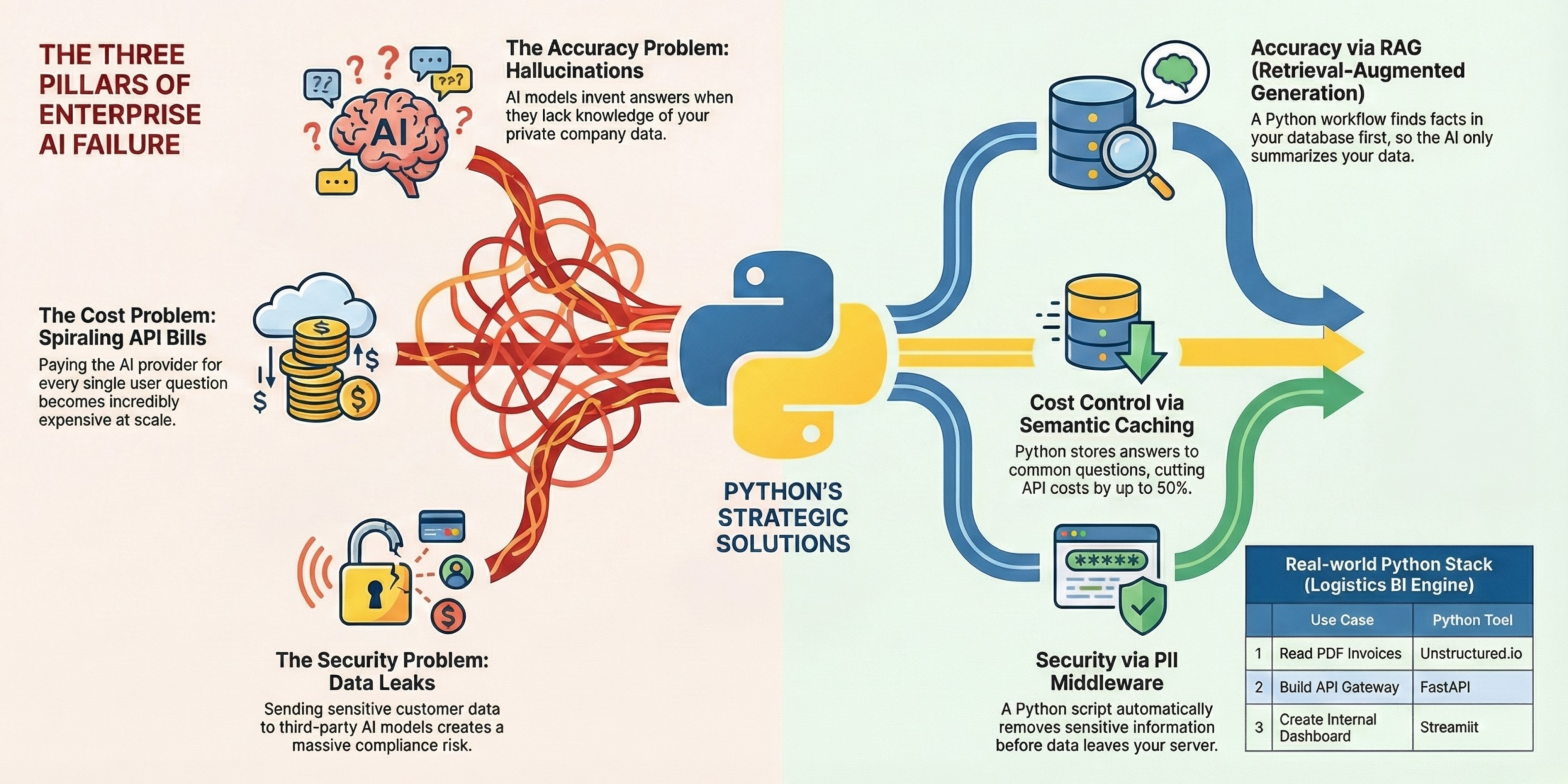
A. The Accuracy Problem (Retrieval-Augmented Generation)
An LLM is trained on public data, which means it doesn’t know your company’s 2024 pricing or your specific internal SOPs. If you ask it a question it doesn’t know, it “hallucinates” (makes up a confident lie).
The Python Solution: We implement RAG. We use Python to create a “Search-then-Generate” workflow.
- The system searches your secure internal database for the facts.
- It feeds those facts to the AI as “context.”
- The AI summarizes the facts. Result: Your AI never guesses; it only cites your data.
B. The Cost Problem (Semantic Caching)
Every time a user asks your AI a question, it costs money (tokens). If 1,000 users ask the same question, you are paying 1,000 times for the same answer.
The Python Solution: We build a Semantic Cache using Python and Redis. If a new question is “semantically similar” to one asked five minutes ago, the system serves the cached answer instantly. Result: You reduce your API bill by 30-50% while improving response speed.
C. The Security Problem (The PII Filter)
Sending sensitive customer data (like credit card numbers or health records) to a third-party LLM is a massive compliance risk.
The Python Solution: We implement a Middleware Scrubber. Before any data leaves your server, a Python script scans the text using Presidio or Regex patterns to redact sensitive information.
- Real-World Business Architecture: A Case Study
Imagine a mid-sized Logistics company with 50,000 unstructured invoices and shipping manifests.
The Goal: A system that lets the finance team ask: “Which vendors increased their shipping rates by more than 10% this quarter?”
The Python Stack:
- Unstructured.io (Python library): To “read” PDF invoices.
- FastAPI: To create a high-performance gateway for the staff to use.
- ChromaDB: A vector database to store the “meaning” of those invoices.
- Streamlit: To build a custom internal dashboard in hours, not weeks.
This isn’t a “chatbot”, it is a Business Intelligence Engine. This is the level of value Python brings to the table.
- Why Python Scales Where Others Fail
A common misconception is that Python is “too slow” for production. In the world of AI, this is a myth.
While Python handles the logic, the heavy mathematical lifting is done by C++ and CUDA under the hood of libraries like PyTorch or TensorFlow. This gives you the best of both worlds: the developer velocity of Python and the computational power of low-level code.
Furthermore, Python’s compatibility with Docker and Kubernetes means that as your user base grows from 10 to 10,000, your AI infrastructure can scale elastically in the cloud (AWS, Azure, or GCP).
- Conclusion: Strategy Over Hype
Generative AI is a powerful engine, but without a robust Python framework, it’s like a Ferrari without a steering wheel. To move from a “cool experiment” to a “revenue-generating asset,” you need a backend that prioritizes data integrity, cost control, and security.
Is your infrastructure ready for the AI shift?
Don’t build in the dark. Whether you are looking to automate your document workflows or build a customer-facing AI agent, the architecture you choose today determines your technical debt tomorrow.
Let’s Build Your AI Roadmap Together.
Our team of Python architects specializes in moving AI from “Prompt” to “Production.”

